

Hercules’ Decision
In this technological age the moral dilemmas we face are practically the same as they have been for the past 10,000+ years. Materialistically, we have mapped the human genome, visited the moon, and built buildings nearly a kilometer high, yet we continually ask the same questions of ourselves. One question that has stimulated many thinkers is: “How much autonomy do I actually possess?”.
I recently completed reading Ryan Holiday’s “Discipline is Destiny: The Power of Self-Control”. As the title suggests this book puts forward the idea that by living a disciplined life we are empowered by our behavior thus enabling us to live a more meaningful existence. Crucially, and antithetical to Stoic metaphysics, so I suspect only symbolically, Holiday presupposes that choice exists. To illustrate this idea, Holiday brings us to the crossroads with Hercules.
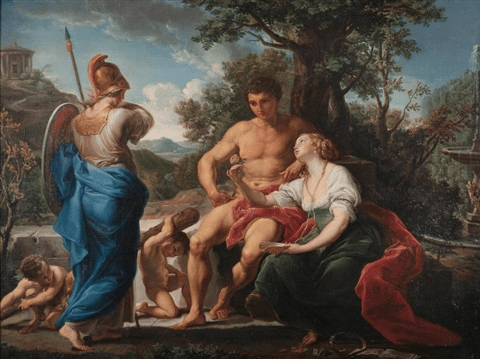
Already famous, Hercules journeys through the Hellenes countryside eventually reaching a Y in the road. On the right a scantily dressed woman promises Hercules all the pleasures of life in excess. “Follow me, enjoy, and indulge in all that is decadent and pleasurable. It is our right”; a tantalizing offer. On the left stands a woman far less promiscuous. Her offer is the inverse: “Struggle and face trial, grind and push yourself to the limit”. Hercules, in his demigod state, is tempted by the hedonistic lifestyle, but takes the path of struggle and is rewarded with a life of glory (and a starring role in a Disney movie). The moral is clear, and particularly important in this comfortable age – what is obtained without difficulty is rarely worth the lack of effort.
In the tale of Hercules at the Crossroads the storyteller suggests that by pushing yourself up to and beyond your capacity, by experiencing trial and failure, though blood, sweat and tears you earn the glory. In choosing the path less enticing Hercules is marked as a Hero for his courage. But suppose, for a moment as I do, that Hercules was always destined to make the decision he made. Hercules was no hero, but only a character acting out his predetermined role in a powerful play.
The Illusion of “Choice”
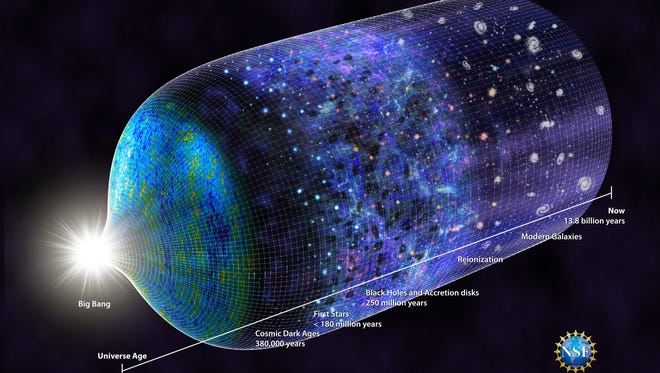
Some undetermined billion number of years ago, the first ever time-recorded reaction brought the universe into existence; the scientific genesis story; the Big Bang. From next to nothing some things appeared and those things are matter. In between those things is space, all of which was linearized by time. For billions of years nothing more than a few molecules and atoms stirred, but in due time bodies formed, one of which was Earth. When the first single celled organism appeared some 3 billion years ago a cellular era began – far shorter than the previous molecular era – which has culminated in the present human age. But how did this happen? Why did the aforementioned things begin to take more complex forms?
Most of us, except for all those who attended a creationist based, can think back to a high school science classes with a teacher who taught for the benefits, pushing in an outdated PBS or, God willing, Bill Nye tape into a VCR machine: a tape outlining the earliest few billions of years of the universe (in 3.5 minutes). We can imagine in our minds eye, however abstractly, matter floating around and colliding with each other, causing chemical reactions, which led to the creation of planetary bodies like Earth on which after a few billion years gave birth to the first unicellular organism. What is harder to imagine is all that was invisibly acting in the universe then- had anyone been there to see it – and what is still acting upon the universe now. I’m speaking of the natural laws.
Imagine trying to play a game of cards without any defined rules. Is Ace high or low? How many points for playing a combo of a 6 and a 9? Does a run need to be cards all in the same suit? If each player plays by their own rules, the outcome is chaos. In order to reach the objective – a winner or a winning team – a set of rules must be agreed upon. So too for the universe, for if every molecule acted independently nothing would ever be achieved. If each part acts independently the outcome is chaos and the universe achieves nothing if not by chance. In order that, billions of years later, a creature appears who is capable of observing and recording the world (for better or for worse), some semblance of order is necessary. Laws beget order. Who or what decided which laws were present in the beginning is another topic of discussion but the proposition that laws did exist when the continuum began is commonly agreed upon – most meta-physicians call these the “first laws” or the “natural laws”.
This is however where the analogy of a game of cards ends. Even though a game of cards is a closed system and statistically there are a limited number of potential game plays, that number is, I would suspect, in the hundreds of millions. The universe however is less fickle than a game of cards, for when the universe Banged Big it just so happened that each subsequent event was immediately determined. Each projectile as it sped away from the Big Bang followed a route decided by the laws of motion, thermodynamics and conservation of energy et cetera. At the point at which two projectiles collided Newton’s third law took effect and depending on the speed at which they were travelling, their mass, temperature, and other key factors, another reaction took place thus leading to a whole new series of reactions whose outcomes were limited to what was possible under the legal structure that gave order to the cosmos (the natural laws).
But if the universe is determined then would it not also be predictable? This is true. When life is able to determine the exact details of the Big Bang and create an algorithm that follows each chain of reactions et ire, then it is my supposition that the universe would become predictable. In that case we could predict when the Yosemite Super-volcano will erupt, when the next big asteroid will make a beeline for earth, and we could also predict the next maneuver of the Russian army or what your girlfriend is thinking. If it is not already obvious I am writing in theory (and in impossibilities concerning the last potentially predictable example). If it was possible to prove exactly what happened at the Big Bang, I suspect that writing an algorithm that could predict the outcome of events that are currently about to occur, some billions of years later, would require a level of precision practically unattainable by the human mind. (And now begins my discussion on the inevitability and necessity of Artificial Generalized Intelligence because clearly humans aren’t shit.)
Species deprecating aside, what my argument is seeking to demonstrate is that any and all matter have determined outcomes if they are operating and colliding with each other on a linear timeline within a given legal structure. To make the most apt analogy of this essay so far, when scientists in a lab wish to prove a particular hypothesis they run experiments which depending on the outcome prove, disprove or are inconclusive for as to the truth of the hypothesis. All other variables remaining constant, when a chemist mixes a set of chemicals together the reaction is determined and becomes predictable if the experiment is replicable. Perhaps that reaction creates a compound that it useful and valuable on the marketplace and thus it is a success, if not then it is a failure and a new set of chemicals is procured (or something like this I’m not a chemist, just an amateur). I hope that my point rings true which is that all chemical based bodies, which exempts nothing, when behaving individually or in collision with each other act according to unchanging physical laws and thus there is always only one possible effect resulting from a prior cause which was in itself an effect (cause-effect-effect-effect-effect ad infinitum).
Yet the illusion of autonomy is so powerful and intoxicating that the word “choice” was devised to substantiate this lie.
The First Free “Choice”
Exiting the meta world let’s instead consider the physical world instead. For as long as you are not an identical twin, you carry a genetic code that is unique. About 9 months before your birth approximately 150 million of your fathers sperm swam towards your mother’s egg, just how his fathers sperm swam towards your grandmothers egg, just how the mailman’s sperm swam towards your unsatisfied great-grandmothers egg, just how the homo habilis sperm swam towards the home habilis egg, and all the way back for as long their have been sexually reproducing species.

When a particularly fast spermatozoa, swimming to the rhythm of some jazz music, burrows into an ovum, a novel genetic code is written. A creature that has never before materialized is suddenly made viable. In the first few days the newly formed zygote is at the highest risk of being lost; 10%-40% of zygotes fail to implant in the uterine lining. For reasons that are within the potential mother-to-be’s control but for most reasons that are out of her control, in the early stages the pregnancy is highly vulnerable to a miscarriage. Twenty weeks in, as the brain of the embryo forms and their neurons begin to fire any misstep by the mother-to-be might mean the child will never experience the joys and pains of life. This period of development is so instrumental that even while they are still in the belly the child is socialized by all that its mother says, hears and feels. If the child senses warmth, support and encouragement, they enter the world better off for it. If the alternative is true the child may face even more of an upward battle once they escape the womb.
Here, I have provided a crash course in prenatal development and its potential risks (for your entertainment) – I get that that it is only slightly controversial that me, a man, has published this and it is also not the point. Now that the child has exited through the birth canal, our lives are almost exclusively decided by our privilege or lack of it – origin, parents health, race, attractiveness, gender, and sexuality to name a few. We begin our lives as victims, or in some cases victors, of circumstances that are all completely out of our control – we have no choice in the matter. If we had the choice surely we’d all be a little taller or leaner, smarter or curvier, and our parents would be a bit more like Barack and Michelle. I hope that you can see so far that I am painting a pretty dire picture of the state of our autonomy. But why worry? Perhaps there’s still a chance you get a say in the matter.
Your parents guide your life until you reach an age of maturity. At that point your scripting kicks in and depending on your temperament you may choose to rebel or to conform. Today you might still be working through your past, or maybe you’ve healed, but either way all that happened before you could make “choices” of your own (not to mention multiple billions of years of evolution) determines the choices you will make today and moving forward.
Genetic determinism is a terrifyingly blunt idea, and is, understandably, harder to accept for some people than others depending on your position in life. It’s downright disrespectful to tell the blind to accept their fate and love life despite the fact that they may never see which is why I am not translating this blog post into braille. Many of you are reading this essay and are clinging on to the belief that we have free will. The common critique is that even while we cannot choose our temperament, our position, our birthplace or our parents, we do decide our own path in life. But when? And more crucially how?
The Implication of Being a Chemical Blob acting according to the Laws of Physics
A normal reaction to a deterministic view is powerlessness. If there is no decision that will shift the outcome of ones life, if each and every decision is an effect preceding from the initial cause – that moment when time, space and matter came into existence – why go on? This is especially true for someone whose life is going downhill, and each engagement with the world is putting them at risk of another defeat. There has to be a way out.
Ultimately, if our lives are determined by chemical reactions all initiating from First Laws that were present at the beginning of time, what is there to do? If every reaction can only operate within this rigid framework and the past is unchangeable, then there is no room for autonomy. Everything follows logically.
This age old theory that I am rehashing, is dependent upon the existence or non-existence of the supernatural and its ability or not to influence objective reality. Permitting that during the last undetermined billion number of years no super intelligent entity operating freely outside of the Laws of Nature adjusted the cosmic universe as we know it then I think that this argument holds weight. Yes, I apologize to my fundamental religious readers but this essay is not for you unless you have begun to climb from out of your self-imposed intellectual enclosure.
As I was writing, if this intellectual thought experiment holds weight, then nothing happens by chance and the potential of each and every reaction was held within the first atoms at the beginning. In other words, all that happens in a world ruled by the strict and unrelenting Laws is determinedly so. Yet, still, we have yet to determine what it is that we ought to do about this? If this is all true, a big if, then each moment of our lives, each surprise, achievement, heartbreak, or sacrifice hardly happened as a result of our own doing but these outcomes were decided several eons ago. For the reader who has built their identity on their good judgement this may be an overwhelming realization – consider yourself blessed.
Perhaps you are accomplished, maybe you have pulled yourself up by your croc-holes, and feel an immense sense of pride for your current position in life. Or perhaps your life has been marked by failure and dismay, and this conclusion is anxiety relieving, if not a complete removal of weight. Either way, and every which way in between, you cannot go wrong with living with humility and gratitude for your existence even if you are a chemically composed blob. Consider that, even if decision-making is illusionary and predetermined you can rest assured that you are still worthy of love <3. And worthy to read Greek myths. Good ole’ Hercules thinking we had a choice. How cute.

While I’ve published this blog post without a bibliography – the joys of writing outside of an institutional setting – I’d like to acknowledge a few of the people who have informed my thoughts on this topic. Despite being the 2nd biggest, and most boring, asshole I know I’d like to thank Sam Harris for introducing me to the ideas of determinism close to five years ago. I’d like to thank Ryan Holiday for his easily understandable and accessible writing in Discipline is Destiny whose ideas were the catalyst for this essay. I’d, also, like to thank the late Alan Watts. His ideas always frustrate me and yet do not fail to shape the way I see the world. Other notable mentions include Henry David Thoreau, Marcus Aurelius, Neil deGrasse Tyson, Michio Kaku, and all my friends who inform my intellect (may fortune find you).
 Becoming Superhuman
Leave a comment