

In a recent cleaning frenzy I noticed, for the quinhundreth time, my messy closet. Clothing lay flat across the shelf. Above my head winter boots, tools, and a box of soap all threatened brain damage. A rolled up rug in the corner had seen better days. Here I was, an adult man with a closet that looked like an abandoned storage room in a Mountain Equipment Co-Op. I needed a fix. And so I opened the page of an undisclosed online retailer, refined my search, and went as far as the third page of results, before finally deciding on a 5ft-7ft extending closet rod. Two days later, a delivery man rested a box on our front door. My closet will never be the same.
This terribly boring anecdote is meant to illustrate one of the 21st centuries most common pastimes: retail therapy *correction* instant retail therapy. Even when the reason for our shopping is more practical, these websites prey on our prim(e)al urge to find the object of our desire. Why wait when you can have what you want in two days guaranteed?
High-speed internet, jet planes, direct messages, freeways, and streaming services are a few of the modern phenomena that permit us to get what we want when we want it. We all have felt the tension in waiting for a text response, sitting in a traffic jam, or when the internet dares take 7 seconds to load a web page (a feeling that I can only imagine is equivalent to stage four brain cancer). Waiting drives us crazy.
We can and, often, do choose immediate gratification. Our species is hard-wired to seek reward, and the sooner the better. Instinctually we are drawn to the sensual – colourful, flavorful, sparkly – intuiting that in possession of these things will increase our chance of mating success. This is partially true but at the same time, obviously, not all rewards are equal. That which is worth the wait is easily replaced by a more accessible cheap, soul and earth destroying, replica. The modern world, and it’s fetishization of speed is corrupting our ability to practice one of the finest of virtues – patience.

Ricky Gervais always wanted to be a pop star. By that I mean that he wanted to be a pop star when he realized that becoming a scientist or a philosopher was less sexy than he first envisioned. Growing up in a middle class family, Ricky reached university, completing a Bachelors degree in Philosophy at the University College of London. After graduating, bored by Camus, Ricky decided to pursue a career in music.
The Ricky we know now balances a gregarious personality with a dose of realism and self-awareness that suggests that he understands the act he is playing – emphasis on play. In a 2016 interview on the Graham Norton show, an image from Ricky’s music career appeared on the big screen.

“That’s called Senora Dancing, let’s move on,” he says feigning embarrassment.
Pointing to the screen and then back at himself, ”I’m not embarrassed by that, I’m embarrassed by this. Everyone’s going, ‘What the f— happened?’ I’ll tell you what happened: Pizza happened.”
His best attempt to impersonate David Bowie failed. So did, ironically, his attempt to manage the British pop group Foregone Conclusion. Music was not it. With bills piling up he settled for an office job.
Most of us know how the story goes. The office job was the catalyst for one of the grandest careers in the entertainment industry. One can only assume that the man will be knighted by the end of the decade. I am led to wonder whether, when Ricky took the office job, was it a surrender? Did the superbly talented Ricky Gervais ever give up on himself?
Apparently, if he did it was only momentarily, because The Office launched ten years later and after some initial growing pains (apparently, the only show that had less viewership was women’s lawn bowling), success came, and a lot of it. The mockumentary soon entered the canon of British sitcoms, making Ricky and co., millions of pounds, earning them numerous awards and accolades, and inspiring an American parody which, far, exceeded it’s British counterpart in views and overall revenue.
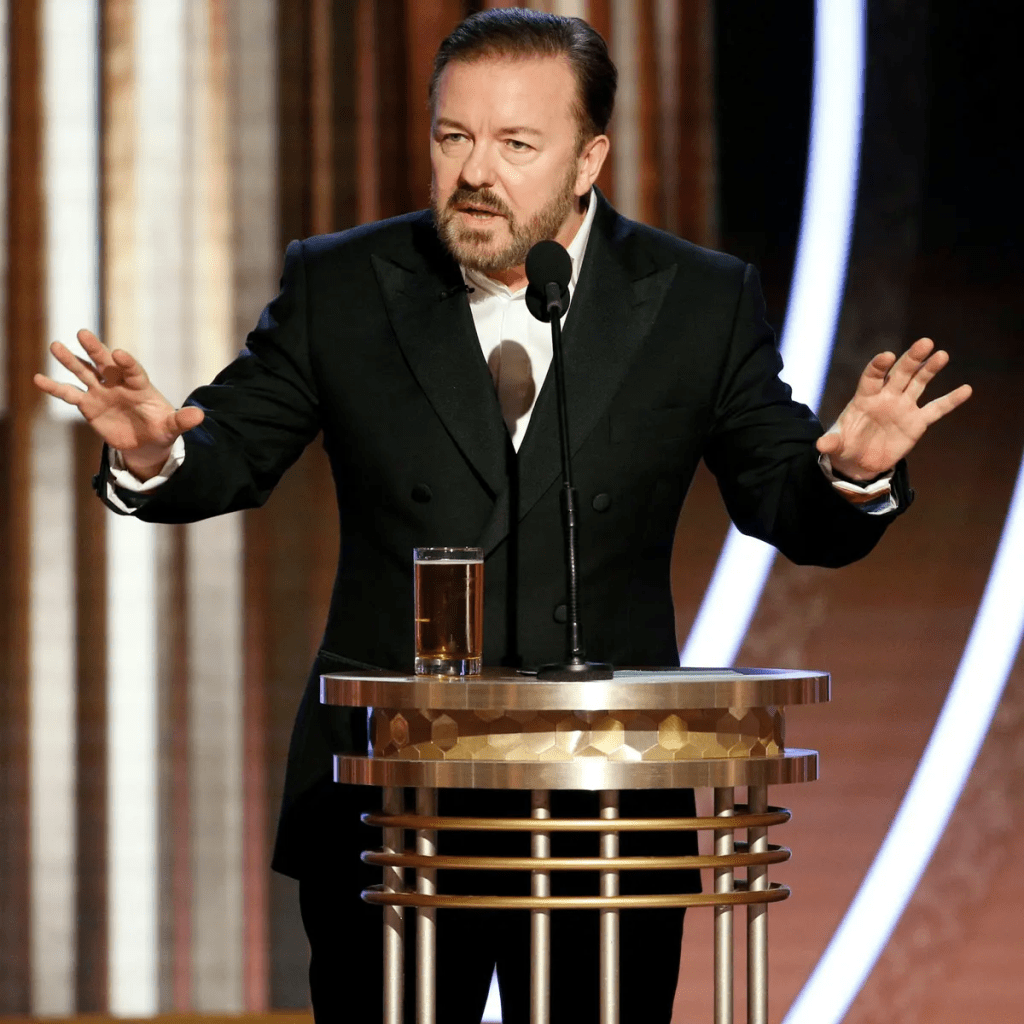
How old was Ricky when he first appeared on the screen as David Brent? 41. In the years following the meteoric rise of The Office, Ricky has starred in and produced numerous television series and films, toured as a stand-up, and tweeted religiously. In recent years he hosted the Golden Globe where in a fiery speech he comedically disarmed the virtue signalling multimillionaires to their shock and to the amusement of many.
The story above is not an exception. There are numerous recent examples of celebrated figures who found their success after years of toil. The late, celebrity chef Anthony Bourdain was drug-addicted and in near crippling debt at the age of 43 when he signed his first book deal. American literary icon, Steven Pressfield, jumped trains and picked fruit for decades before publishing his seminal work “The War of Art”. As somewhat of a writer myself these two examples are my favorite but honorable mentions include the likes of Julia Child, Joe Biden, Martha Stewart and Stan Lee.
To believe that every one of these stars maintained perfect composure and patience throughout their years of striving is to ignore the human tendency to want, and to want now. If you were to tell a 35 year-old Anthony after a six-day binge to “keep your head down, you will someday become one of the most well-respected celebrity chefs and food show producers of all time”, you have have been laughed at. Many talented people never gain recognition in their time, or ever. So much talent fades into obscurity.
What separated these greats from the masses around them was a commitment to their trade. Or perhaps it was desperation. Luck played a role, also. Patience is not simply the act of waiting for good things to manifest themselves, it is the faith that intentional and self-correcting progress in search of a goal might result in its achievement.
Respectable careers, good character and reputation, and success in service of healthy families, resilient communities, and a peaceful world, take effort. They are the result of years of directed behavior in search of what is cerebrally proximate but physically distant aka our dreams. Nothing meaningful is obtained through lack of effort, so claim the sages. The distance between our ideal self and our current reality appears vast at times, and fear leads us to underestimate our current capabilities. Will we ever realize our latent potential? What if we get unlucky?

Respect, trust, admiration, and influence, are earned at a cost. They require years of discipline, consistency, selflessness, and measured risk. By sacrificing what you desire in the present in lieu of what you most desire increases the likelihood of success. But there’s a catch, ignoring that you could wake up tomorrow and find a lump (while walking through a cemetery in a 60 minutes interview Ricky claimed he’d like his tombstone engraved with “Had a laugh, then found a lump”), you cannot have the world and not lose some of what is most important.
Oh so you want the house on the hill, a new Bugatti, and a husband that loves you unconditionally? Choose one.
Say you choose the Bugatti. Crucially, your ability to be satisfied with that decision is conditioned by the number of your desires that are left unfulfilled. Perhaps besides a stunning view and a trophy partner, you also wanted to sail from pole to pole, build a multi-media entertainment corporation, and juggle in front of an adoring audience at Carnegie hall.
There is a direct, negative correlation between the degree of your happiness and the number of your desires that are left unfulfilled. The new Bugatti may accelerate from 0-100k in 2.4 seconds (it does), and the crowds in New York may want you to sign their balls, but for as long as you desire more than what you currently have, your smile will always be a facade. Happiness eludes all those who believe the Universe owes them more. As if the Universe gives a f— about how many things you want or own.

The correlation between desires and happiness is not a coincidence. Unfulfilled desires are a leading cause of suffering. While only a few corporations escaped the .com bubble of the late 1990s, those who did took strongholds in the wealthiest global economy of all time. With the invention of online retail, smartphone, and social networking, almost everyone can watch this wealth being created in real time. The Jeff Bezos, Elon Musks, Oprah Winfreys and Warren Buffets of the world remind us of how small our net worth is. This comparison is the root of suffering. Oooooouummmmmm (for you cave men and women out there – that is a Buddhist meditational chant).
Yes, the Buddha had a thing or two to say about this topic. In his infinite wisdom he taught that the root of suffering is desire. Now, most of us don’t have the time, or patience, or ass, to sit underneath the Bodhi tree until we are enlightened. The aesthetic life is reserved for a tiny minority of people, all power to them. Most of us desire success; desire provides us with the motivation we require to better ourselves.
Perhaps suffering, then, is a necessary component of a life of striving. It doesn’t take a genius to notice that “strive” and “strife” are only off by one letter. A life well lived is lived at the razor sharp edge of pain and freedom from pain. But how can you patiently wait for something if you do not know what that something is, exactly?
Some people call Mark Manson the modern Buddha. I, unapologetically, agree with that statement if only to test the equanimity of my Buddhist readers. Mark’s view incorporates the axiomatic, Buddhist statement “Attachment is the root of all suffering” but unlike the Buddha he does not go as far as to suggest that we should seek non-attachment.
Taken to its logical conclusion, Buddhism leads us to a monastic life in the woods, a life that, significantly, more people talk about wanting than the number who actually choose it. The perfect Buddhist is left with only one possession: the clothing on her back. As a result, a philosophy oriented toward the constant rejection of material possession will lead us to shame in a world where possessions, tangible and intangible, actually count for something – at least, protection from the somewhat heartless conditions of the natural world and a little animal comfort.
As an alternative to limiting all desires, Manson suggests that we should discern what is worth “giving a f— about”. This clarity brings purpose and an, almost, immediate ability to decide how we should spend the limited time on this earth. As soon as our vision is 20/20 the waiting that is required to earn whatever few and important things we decide upon – like rain shower heads and trips to Greece – becomes sufferable.

The man who played David Brent started his career with a dream – he wanted to be a pop star. When Ricky told his mother this dream she retorted “pop star is just another word for junkie”. Against all odds, Ricky realized his goal when The Office hit television screens across the UK. But as his mom predicted his success made it more difficult for him to avoid the junk, namely junk food. The bloke is a bit of an oinker.
Ricky Gervais is now a household name. With each passing day he gains an increasing amount of notoriety – more and more people either love him or hate him (not that he seems to care either which way). Ricky’s influence on the culture is solidified. Though he was born into a middle class family in the stone age, now, as an old man, the modern era allows him to reach an audience of millions from his sofa.
His patience through it all is one of the, many, virtues that have allowed Ricky to achieve great success. Good luck shone on Ricky, he had no control over that, but by attending to what was in his control success came. Beyond stardom, Ricky has sustained a 40 year plus relationship; undoubtedly one his greatest accomplishments (though he’s only ever claimed the contrary in good humor) and a contributing factor to his, lasting, success.
In a world where many of those who gain the most power offer fix-all solutions – you are unhappy because of carbs, self-limiting beliefs, the size of your house, or Mexicans – it is difficult to sort through all the junk and reach the source. The belief that one person, one purchase, one habit, one type of food will save you is a comfortable delusion. A delusion that most everyone indulges in on occasion.
Alternatively, any person can pick a lofty goal and begin to work towards it with determination. Once selected, a process begins where one consciously and unconsciously determines which actions are in alignment with that end goal and which are misaligned. This is an uncomfortable process, made more difficult by circumstance, corrupted by pride, and, as a result, so many of us refuse to choose a destination.
The tragedy of it life is that no matter how lofty your goal, how patient you are in achieving it, how generous you are to your neighbors, how much love you share, and how often you deny your current desires, some idiot may still cross the center line. We cannot predict with any degree of certainty when our day will come. For as many people like Ricky there are an equal or, perhaps, exceeding number of stories like Aaliyah, Princess Diana, Notorious B.I.G., Tupac (so as not to be caught favoring one gang or the other), Paul Walker, and Bob Marley, all who died with unrealized potential in their bones.
These stories are sad because we believe that if they had lived for longer they would have provided even more value to the world. Their ambition was convincing. We identified that their intangible qualities were worthy of admiration and emulation. We believed that their success would bring even more success. So you better try because even if you die trying, at least, you might be remembered for your effort.
“Nothing is impossible to [they] who will try”
– Child prodigy, and rich boy, Alexander of Macedonia
 Becoming Superhuman
Leave a comment